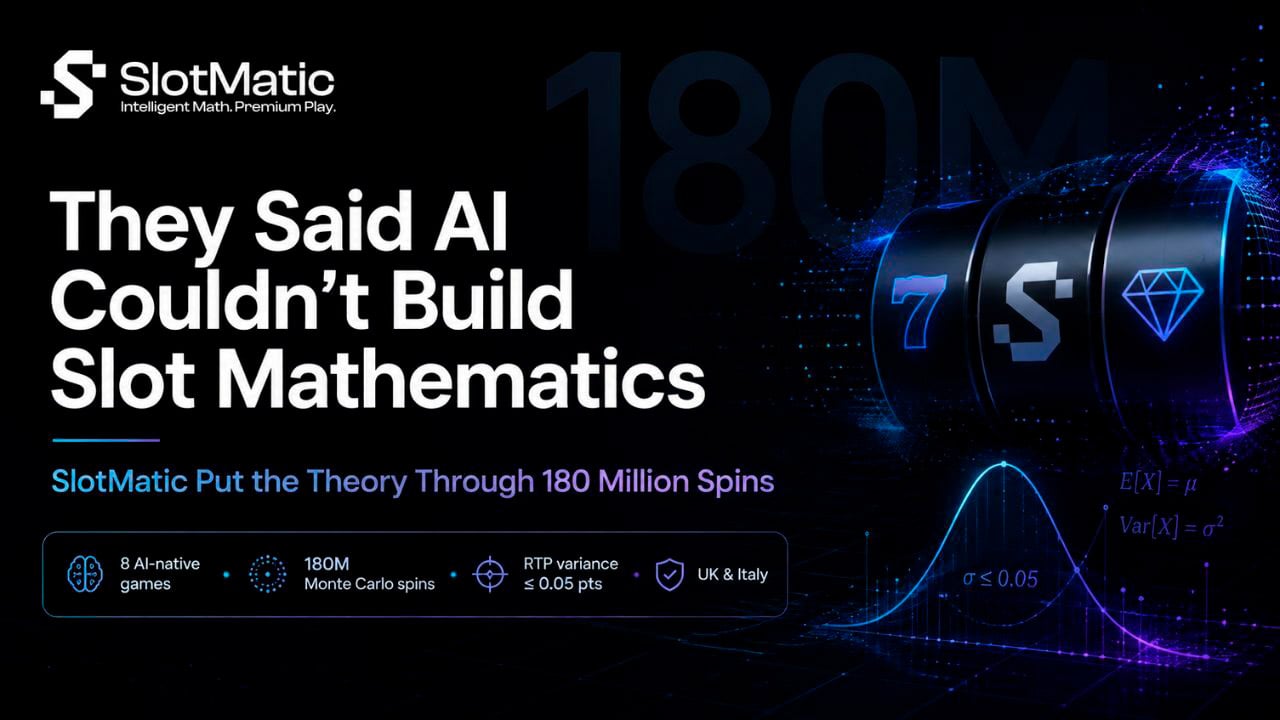
In this article, SlotMatic explores how its AI-native game development platform has taken eight slot titles from concept to certification-ready products, highlighting what it sees as a key step toward AI-powered game creation for regulated markets.
Eight AI-native games have completed development, mathematical validation, laboratory testing and regulatory remediation for the UK and Italian markets, with theoretical and simulated RTP results converging within 0.05 percentage points.
Artificial intelligence can generate artwork, accelerate software development and produce playable game concepts. The more consequential test for regulated gaming, however, is whether an AI-native platform can create a complete real-money slot game whose mathematics, engine, interface, documentation and player-facing functionality can withstand independent examination.
SlotMatic says its first portfolio has reached that point.
The company has taken eight AI-native slot games through development, simulation, testing and regulatory remediation for the United Kingdom and Italy. Final certification reports are expected following completion of the laboratory’s reporting and quality-assurance procedures.
Across the portfolio, SlotMatic conducted approximately 180 million Monte Carlo simulation spins. Individual games were tested over between 10 million and 50 million rounds, depending on their mathematical profile and volatility.
The maximum reported difference between theoretical RTP and simulated RTP was 0.05 percentage points. Pumpkin Night produced a simulated RTP of 94.62% after 50 million spins, exactly matching its theoretical RTP at the reported precision.
“People told me that AI could not build serious slot mathematics and that SlotMatic would be little more than another wrapper around a large language model,” said Domenico Vacchiano, SlotMatic Founder and Chief Innovation & Technology Officer.
“Instead of accepting that assumption, we kept building, testing, improving and validating. Approximately 180 million simulated spins have now given us measurable evidence of what the architecture can achieve.”
Beyond AI-generated assets
Much of the discussion surrounding generative AI in gaming focuses on speed: how quickly a platform can generate graphics, animation, audio, code or a playable prototype.
SlotMatic wants to shift the conversation towards product quality, mathematical reliability and certification readiness.
The platform was designed to support the connected production chain of a slot game, including concept development, mathematical modelling, Monte Carlo simulation, game-engine production, graphics, animation, audio, quality assurance, regulatory documentation and certification remediation.
The challenge is not producing each component individually. It is preserving consistency across the entire product.
The mathematical model must define the correct probabilities, RTP and prize distribution. The engine must reproduce that model accurately. Paytables must change correctly with the stake. Animations must correspond to valid game events, while the rules must describe exactly the same product examined by the laboratory.
“The difficult problem was never creating one image, one feature or one piece of code,” Vacchiano said. “It was preserving coherence from the first mathematical hypothesis to the final build submitted for independent testing.”
Built on SlotMatic’s PRC Foundation
SlotMatic attributes the efficiency of its UK and Italian certification workstreams to its PRC Foundation: a Production-Ready, Certification-Ready architecture designed for regulated game development.
Rather than rebuilding the technical and regulatory infrastructure for every title, each game begins from a reusable foundation incorporating a production-ready engine and client, mathematical simulation tools, dynamic paytables, multilingual localisation, regulated-market rules, demo and real-money consistency, autoplay controls, visual game history, feature-testing tools, structured PAR sheets and technical versioning.
SlotMatic also developed a testing tool capable of activating free spins, bonus features and specific winning combinations, helping laboratory testers examine events that could otherwise require an impractical number of ordinary rounds to reproduce.
“PRC does not mean bypassing certification,” Vacchiano explained. “It means entering certification with a game engine, client, mathematics and compliance framework that were built for that process rather than adapted afterwards.”
Eight games, 180 million spins
The reported results were:
- Dragon Relics: 93.02% theoretical RTP and 93.04% simulated RTP after 15 million spins;
- Golden Pharaoh: 93.24% theoretical and 93.27% simulated after 10 million spins;
- Aqualis: 96.23% theoretical and 96.28% simulated after 15 million spins;
- Sakura Spins: 95.77% theoretical and 95.82% simulated after 35 million spins;
- Book of Ramesses: 94.00% theoretical and 94.02% simulated after 15 million spins;
- Pumpkin Night: 94.62% theoretical and 94.62% simulated after 50 million spins;
- Quantum Reels: 94.81% theoretical and 94.77% simulated after 25 million spins;
- Crystal Kingdom: 94.16% theoretical RTP and 94.17% simulated after 15 million spins;
Monte Carlo simulations naturally produce statistical variation. Their significance lies in convergence: as the number of simulated rounds increases, the observed RTP should approach the theoretical model.
SlotMatic also expanded its PAR sheets so laboratories could reconstruct the theoretical RTP methodology rather than rely solely on a declared percentage.
From technical proof to industrial opportunity
Charles Herisson believes the project demonstrates SlotMatic’s ability to bridge the gap between AI experimentation and commercial deployment.
“Many AI projects can create an impressive demonstration, but very few can transform that demonstration into a product operators can deploy in regulated markets,” Herisson said.
“SlotMatic is building a body of technical proof and converting that proof into an industrial platform. When theoretical and simulated RTPs converge across tens of millions of spins, the conversation moves from marketing claims to demonstrable performance.”
Francesco Maddalena said the work also showed why compliance must be treated as part of product engineering.
“Speed is valuable, but trust is decisive,” Maddalena said. “AI-native development can increase efficiency, but it must preserve accountability, verifiable mathematics and the ability to respond transparently to independent scrutiny.”
SlotMatic does not claim that AI removes the need for mathematicians, engineers, artists or compliance specialists. Its proposition is that specialised systems and experienced professionals can work inside a common architecture, reducing fragmentation and inconsistency.
“Regulation did not slow down our invention,” Vacchiano concluded. “It forced us to make the invention real.”
“A prompt can generate an idea. A disciplined system can turn that idea into mathematics, software, art, sound and evidence. Speed creates attention. Accuracy, reproducibility and certification readiness create an industry.”
NYCE perspective: evaluating AI-native game production
For operators and studios, the useful distinction is not whether AI participated in development, but whether the final product can be audited. The evidence to compare includes reproducible mathematics, the gap between theoretical and simulated RTP, version-controlled documentation, test tools and the status of independent certification.
That makes the useful comparison one of systems rather than output speed. The Nirmata Play Universe and its iGaming infrastructure model provides a related view of how shared technical foundations can connect product development and delivery.
Explore suppliers and solutions in the NYCE Product Marketplace, or contact NYCE to discuss a commercial introduction.
Originally published in the NYCE Marketplace section on Yogonet on August 5, 2026.